

I propose, that when God created the universe, they used mathematics.
In biology, the DNA strings may define the building blocks for constructing organisms, but mathematics can describe how the pieces connect together. An example – Why does a Monarch butterfly’s wings have such distinctive patterns? It is mostly due to genetic coding. Scientists have identified several genes that control wing patterns in Monarchs.
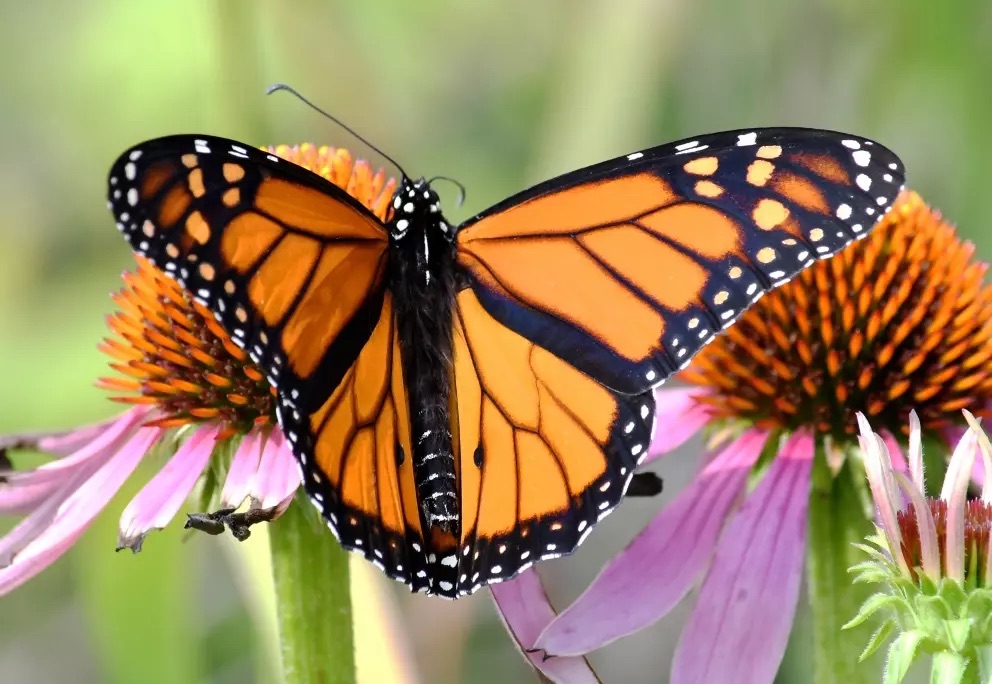
Now here is the bit that fascinates me. In 1952, Alan Turing, of code breaking fame, develop a mathematical method to describe how the genetic coding, that creates specific cells in organisms, further causes the cells to arrange themselves in distinctive and repeatable patterns. His model is called Turing Patterns.
“Turing proposed a model wherein two homogeneously distributed substances (P and S) interact to produce stable patterns during morphogenesis. These patterns represent regional differences in the concentrations of the two substances. Their interactions would produce an ordered structure out of random chaos.” (editorial, 2022)
Turing Patterns can be used to graphically depict butterfly wing patterns. How this process works is described in a thesis by Tarryn Vavruska. She provides a simplified, computer simulation, using Turing’s model, to generate a graphical representation of part of a butterfly wing.
In Vavruska’s project, “a small region of a butterfly wing was modeled using a system of two morphogens over a two-dimensional trapezoidal surface. This region included an eyespot from which it was assumed one of the morphogens was emitted. After solving this system using the Finite Element Method, a banded pattern is formed over the region. Therefore, repeating this process for the different regions of the wing can reproduce a pattern commonly found on butterflies.”
The actual mathematical methods confound me and I am not going to muddle up this essay by trying to explain them here. What I want to point out is the amazing fact that there exist among us people who can discover ways to describe how the universe works. These ways, in turn, give others the tools to learn more and more about how things work.
And it just goes on.
Resources
- The Complicated Artistry of Butterfly Wing Patterns and Colors, Katharine Martin, Gold Biotechnology.
- The Chemical Basis of Morphogenesis, Alan Turing, Philosophical Transactions of the Royal Society of London, Series B, Biological Sciences, 1952.
- Turing patterns, 70 years later, editorial, Nature Computational Science, 2022.
- Turing Patterns and Butterfly Wings, Tarryn Vavruska, Thesis Carroll College, 2015.
- Morphogenesis, Wikipedia. This process “causes a cell, tissue or organism to develop its shape.”
- Turing Pattern, Wikipedia.
- Alan Turing, Wikipedia.
- Turing Pattern Project, University of Sheffield.
- Photograph from the Unites States Fish and Wildlife Service. Monarch butterfly on a purple coneflower, Jim Hudgins/USFWS, Public Domain,
 |
| Visits: 7 |
